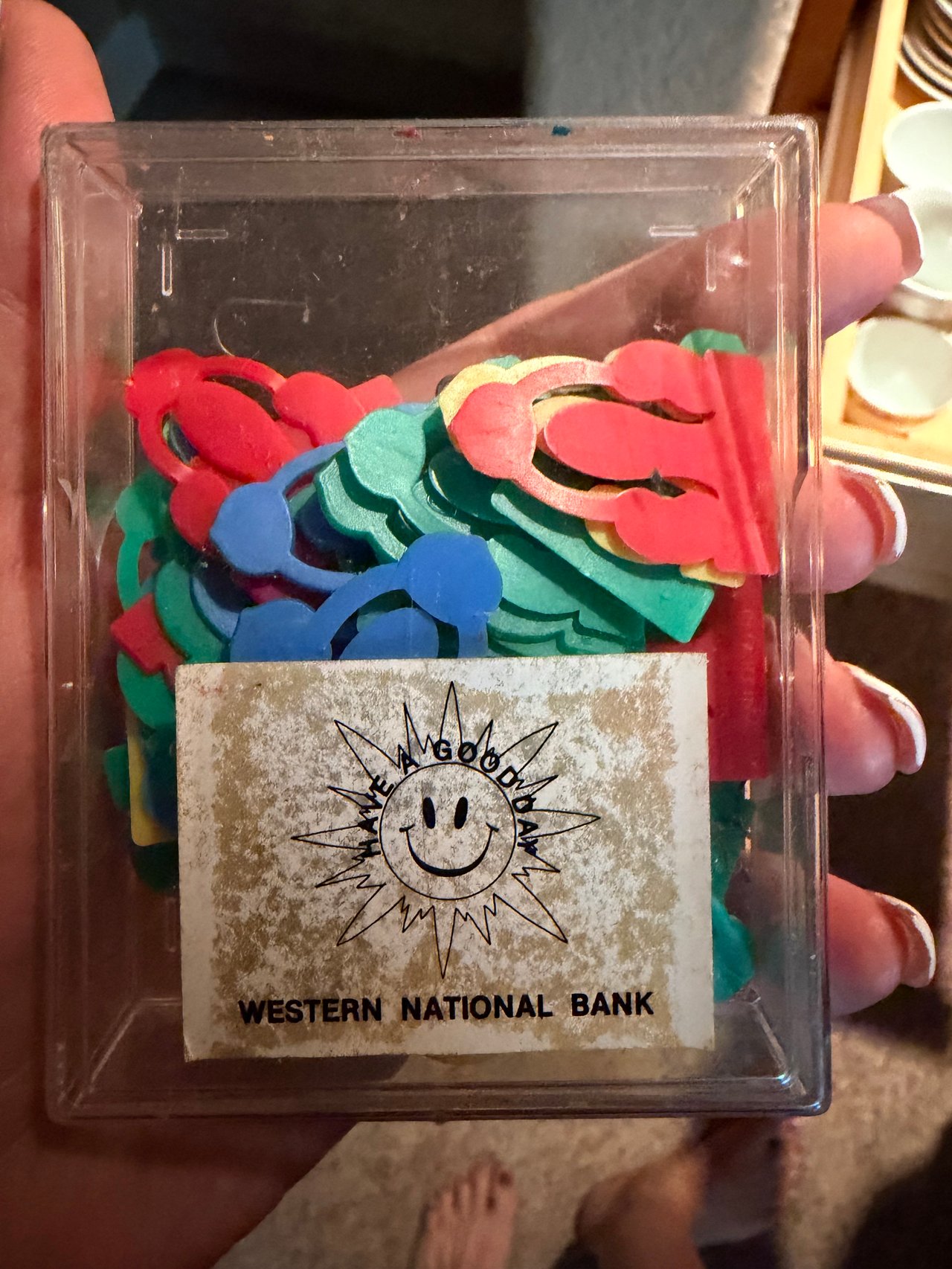
Stuff is never just stuff!
This past weekend, my mom and I started helping my grandfather sort through and pack up his things. In the next couple months, he will be moving into a retirement community, which means we need to figure out what is going with him, what isn't, and eventually get his house ready to sell. Keep an eye out for that one, by the way, because his house and neighborhood is awesome!
I knew this process would be difficult. However, I wasn't prepared for just how exhausting it would be. I am a highly productive person. Sitting still really isn't my thing, and I can usually accomplish more before noon than is probably reasonable. One morning of going through my grandfather's kitchen sent me home for a three-hour nap, followed by eight hours of sleep that night. For anyone who knows me, neither of those things is normal.
The work wasn't physically difficult. I was simply emotionally spent.
For better or for worse, one of the things my grandfather and I have in common is what I lovingly refer to as the stressor gene. I worry about everything and everyone, all the time. I worry about things that are happening, things that might happen, things that probably won't happen, and sometimes even things that haven't even occurred to anyone else yet. It is a tremendously useful skill if your goal is to lose sleep and sanity.
This particular situation has given my stressor gene plenty to work with. If you asked my grandfather, I'm certain he would say the same.
Like anyone downsizing, we started making piles. Keep. Sell. Donate. Trash. It sounds simple enough until you're standing in front of someone's entire life trying to decide which label applies to each thing.
My grandfather's position was straight forward - keep everything because he uses everything. Of course, he uses everything. Right now, it's all there to use.
He has five of the same little bowl he uses to crack eggs. Does he use them? Yes. Does one man moving into a two-bedroom apartment need five egg-cracking bowls? No.
Then there is the giant Sunbeam mixer. He bakes a lot, the mixer works perfectly well, and it is what he knows. Mom looks at it and sees something heavy and bulky that could easily be replaced by something newer, lighter, smaller, and equally functional. He looks at it and sees his mixer...and I get it.
As we continued, a pattern emerged. He wanted to keep most things, and the things he was willing to part with, he wanted to give to people he cares about. I get that, too.
You spend an entire lifetime accumulating "stuff". Some of it is useful. Some of it is valuable. Some of it was given to you by someone you loved and holds sentimental value. Some of it reminds you of a trip, a celebration, a person, or a Tuesday afternoon forty years ago that nobody else even remembers. Some of it belonged to someone who isn't here anymore, and getting rid of the object somehow feels uncomfortably close to getting rid of a piece of them.
So. Much. Stuff.
Let's be honest, we all have it. Closets, cabinets, garages, basements, and storage rooms filled with things we don't really need, yet somehow our stuff provides comfort. It surrounds us with evidence of the life we've lived. It's also what ties us down and, occasionally, holds us hostage.
At some point during the weekend, I realized just how much my grandfather, my mom, and I are alike. He didn't want to get rid of his things. We didn't want him to get rid of his things. All three of us knew, logically, that some of it absolutely has to go.
Logic wasn't really the problem here. Our emotions often tend to get the better of us.
There were things we came across that we knew my grandma had kept for a reason, but we didn't know the reason, and it's too late to ask her. We knew something must have mattered to her because she'd held onto it, but we didn't know where it came from, who gave it to her, or what memory she'd attached to it. Without the story, an object that meant something to her becomes another thing someone else eventually has to put into a pile. Those were the pieces that were surprisingly hard for me.
Then there were the things where we did know the story. My grandma had these beautiful little crystal bowls she always served fruit in at brunch. They're small and certainly not necessary. A man living alone in a two-bedroom apartment could probably navigate the rest of his life quite successfully without owning them. However, they're not really fruit bowls. They're brunch with Grandma.
They're family gathered around the table. They're conversations and laughter and whatever else was happening in our lives at the time. They're Grandma putting fruit into those bowls because that's simply how she did it. Serving fruit from them today makes something familiar return, even though so much has changed.
How do you put that in the "sell" box!?
Personally, I don't want to let go of any of it. Every room in that house holds memories of my grandparents and some of the best parts of my life. Holidays, sleepovers, celebrations, meals, conversations, ordinary days that didn't seem important enough to memorize at the time.
Twenty years later, you touch some random object and suddenly you're right back in a moment...a moment your brain thought it had filed deep in the depths of the past.
That's the part about our stuff I hadn't really considered before. Objects become little storage devices for memories. We don't necessarily need them to remember, but sometimes seeing or touching something unlocks a memory we didn't even realize we'd stored away. Once those memories reemerge, we want to hold on to them for as long as we possibly can.
Eventually, of course, someone has to decide what happens to all of it.
In real estate, we see this on a regular basis. Moving has a way of forcing decisions people have successfully avoided for decades. Downsizing makes those decisions even harder because you're not simply moving your life from one house to another. You're deciding which parts of it physically fit into your next chapter and which ones don't.
We've helped people navigate versions of this transition many times. I've understood the difficulty of every decision...of every step. I've had compassion for people who couldn't decide what to keep or who became overwhelmed by what looked from the outside like a relatively straightforward process.
Now, in retrospect, I'm not sure I truly understood it.
Now I'm standing in my grandfather's kitchen trying to help him let go of things I, myself, can't let go of.
I don't know how to do that.
I don't know how to help him leave a home filled with memories when I don't want to lose the home either. I don't know how to watch him move further away from me and pretend the practical considerations are the only things I'm thinking about. I don't know how to reconcile being excited for him to have a safer, easier next chapter while spontaneously wishing nothing had to change.
I know this experience will make me better at my job. Every time we personally experience one of life's transitions, we gain a kind of empathy that can't come from training or experience on the other side of a transaction. The next time I walk into a client's home and they're struggling to part with something that looks completely unnecessary to me, I will know there may be a whole story sitting inside that object that I cannot see.
For now, I'm not the REALTOR helping someone through a transition. I am the granddaughter who isn't ready for this particular chapter to end. Unfortunately, my readiness doesn't really have much to do with it.
We will keep sorting, and packing, and we will probably have a few spirited debates about egg-cracking bowls and small appliances along the way. We'll laugh, we'll get frustrated, and I'm certain I'll come home completely exhausted more than once before we are finished. I'm certain we will also keep some things that make absolutely no practical sense to keep, but they will make me feel better about the purging process.
I'm learning to be ok with this because sometimes a fruit bowl isn't just a fruit bowl.
But really, if there is something you need, let me know. We probably have it, and Lord knows I don't need another of "it".