If Denver home prices make your first purchase feel like a stretch, you are not alone. With a median sale price of $630,000 in March 2026 and an average rent of $1,950 in April 2026, many first-time buyers are looking for practical ways to lower monthly housing costs while still getting into the market. That is where house hacking can make sense. If you want to live in your home, offset part of your payment, and build equity over time, this guide will walk you through how house hacking works in Denver, what rules matter most, and where to be careful. Let’s dive in.
What house hacking means in Denver
House hacking usually means you live in the home and rent out part of it. In Denver, that often looks like renting a basement apartment, using a legal accessory dwelling unit, buying a home with a separate rentable space, or sharing the home with roommates.
This strategy can appeal to first-time buyers because it blends homeownership with rental income. In a market where purchase prices are high relative to rent, the goal is not instant wealth. It is to reduce your carrying costs while building equity and learning what ownership really looks like.
Why Denver buyers consider it
According to the latest Denver housing market data from Redfin, homes in Denver were selling in about 19 days in March 2026, with a median sale price of $630,000. At the same time, Zillow reported Denver average rent at $1,950 as of April 13, 2026 in the research provided for this article.
That gap helps explain why many buyers explore live-in rental strategies. If part of your home can produce income, even modest rent can help with your monthly budget. Still, your actual results depend on financing, repairs, vacancy, insurance, taxes, and whether the space is legally rentable.
Common house hacking setups
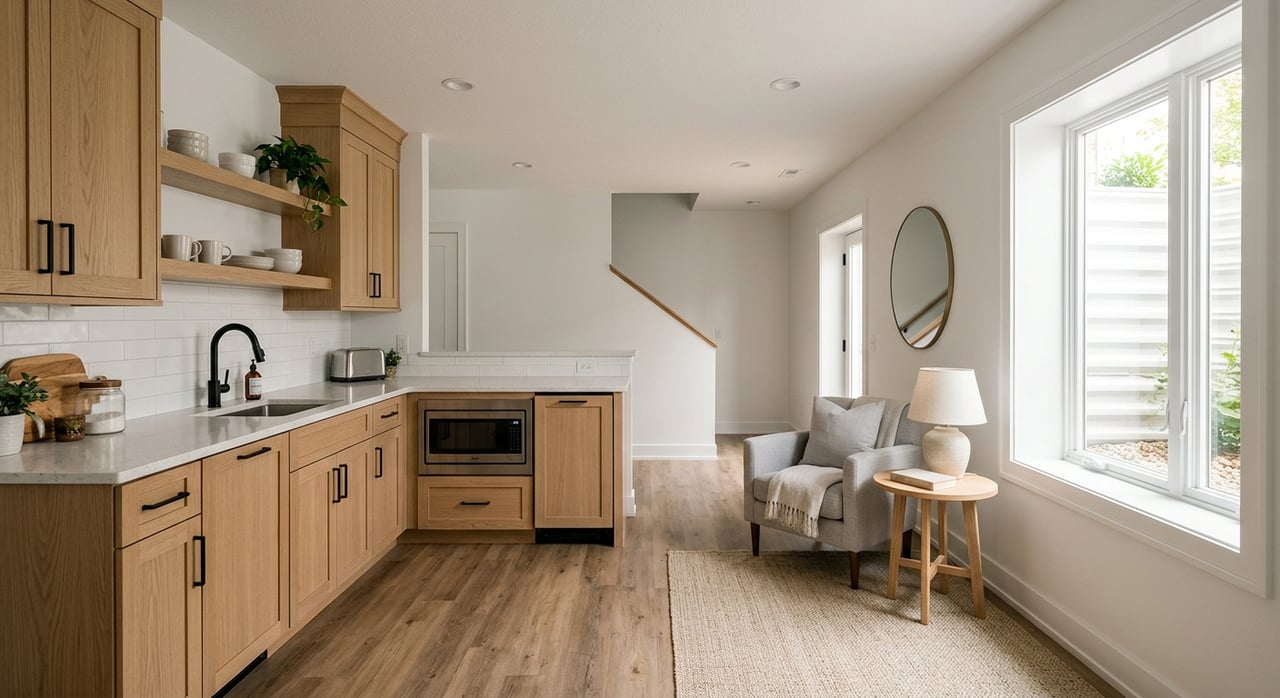
Basement apartment
A basement apartment can be one of the more practical ways to house hack in Denver. The city specifically notes that ADUs can take the form of basement apartments, along with garage apartments, carriage houses, or additions.
That does not mean every basement is ready to rent. If you are counting on basement income, you need to confirm the space is lawful and meets Denver requirements before you build your budget around it.
ADU on the property
Denver’s citywide ADU update made this strategy more visible. The city says ADUs are now allowed in all residential areas, with the measure taking effect on December 16, 2024.
Denver also says the change expanded ADU access to about 70% of city land, up from 36% before. For buyers thinking long term, that creates more opportunities to purchase a property now and plan for future rental flexibility, though zone-specific standards and site constraints still matter.
Separate unit home
Some homes already include a layout that works for shared living or a separate unit. This can be attractive because you may avoid a major renovation right away.
Even so, you still need to verify what is legally permitted. A setup that looks rentable is not the same as a setup that is licensed, permitted, and approved for occupancy.
Roommate strategy
For many first-time buyers, the simplest version of house hacking is just sharing the home with roommates. This often involves the least construction risk and the fewest upfront costs.
In Denver, that can be more straightforward than creating a new unit from scratch. It may also be easier than relying on short-term rentals, which come with tighter local rules.
Denver rules you need to know
ADU rules and permits
If your plan involves creating or legalizing an ADU, Denver’s rules are a major part of the decision. The city describes ADUs as self-contained living spaces and says new ADUs require zoning, building, and sewer use and drainage permits.
Denver also says ADUs must be built by a licensed contractor, must have their own address, and must receive a Certificate of Occupancy before anyone can live there. You can review the city’s ADU permit requirements before you make an offer on a property that depends on future rental income.
There is also an important timing issue for some buyers. In single-unit zone districts, Denver says the owner must live on the property when applying for permits to build an ADU on an existing home, unless the main home and ADU are being built at the same time.
Long-term rental licensing
If you plan to rent the property, or part of it, for 30 days or more, Denver requires a residential rental property license. The city also says the owner or operator must provide a written lease and a copy of the Denver Tenant Rights and Resources notice at lease signing and again if rent demand is served.
You can review the city’s residential rental licensing program details if long-term rental income is part of your plan. This is one of those rules that is much easier to handle upfront than after closing.
Short-term rental limits
Airbnb-style house hacking is more restrictive in Denver. The city requires a short-term rental license and says the property must be the host’s primary residence.
Denver also states that a property that is not the host’s primary residence is not eligible for a short-term rental license. If you are considering this angle, read the city’s short-term rental rules carefully. In many cases, long-term roommate or in-home rental strategies are simpler and more predictable.
Financing for a first-time buyer
Owner-occupant financing is usually the foundation of house hacking. Under the HUD FHA handbook, at least one borrower must occupy the property within 60 days of signing and intend to continue occupancy for at least one year.
That matters because house hacking is not the same thing as buying a pure investment property. If you are using an owner-occupant loan, you need a plan that truly fits the occupancy rules.
Assistance programs to explore
If the biggest hurdle is cash to close, Denver-area buyers may have options worth discussing with their lender. CHFA down payment assistance is available to buyers using one of its first mortgage programs. CHFA says its grant option can provide up to the lesser of $25,000 or 3% of the first mortgage with no repayment, while its second mortgage option can provide up to the lesser of $25,000 or 4%, repaid later under stated conditions.
Denver also highlights the metroDPA program, which the city says may be available to qualified borrowers with income up to $210,150 and a credit score above 640, sometimes 620. The assistance is described as a 30-year deferred second mortgage with no monthly payments and no interest.
For some buyers, the right strategy is not just finding the right home. It is pairing the home search with financing and assistance options that make the monthly numbers more realistic.
Risks to think through first
House hacking can be smart, but it only works well when you plan for the less exciting parts too. Before you rely on rental income, make sure you understand the risks tied to legality, condition, and day-to-day management.
Permit and renovation risk
If your plan depends on adding or converting an ADU, treat it like a real construction project. Denver’s process includes zoning, building, and sewer review, plus inspections and a Certificate of Occupancy.
Because Denver says homeowners cannot DIY ADU permits and the work must be done by a licensed contractor, timelines and costs can move more than expected. A property with “future rental potential” is not the same as one that is ready to perform on day one.
Landlord responsibilities
The moment you become a landlord, Colorado rental law matters. According to the Colorado renters’ rights summary, a security deposit cannot exceed two months’ rent and generally must be returned within 30 days after tenancy ends, unless the lease allows up to 60 days.
The same summary says landlords cannot withhold deposits for normal wear and tear, and bad-faith withholding can lead to treble damages plus attorney fees and court costs. Colorado’s updated warranty of habitability law also requires a rental to be fit for human habitation at the start of occupancy and maintained that way through the tenancy.
Vacancy and repair costs
Rental income is rarely perfect or uninterrupted. Tenants move out, repairs come up, and older homes can surprise you.
That is why it helps to underwrite conservatively. If the home only works financially when every room is rented every month with no repairs, the plan may be too tight.
How to evaluate a Denver house hack
Before you write an offer, it helps to slow down and run the property through a simple filter.
Ask these questions
- Can the current layout be rented legally under Denver rules?
- If an ADU is planned, what permits, contractor work, and timelines will be required?
- Will you need a residential rental property license for rentals of 30 days or more?
- Does your financing require owner occupancy, and does your plan match that requirement?
- If rental income is delayed, can you still afford the home?
- Are you comfortable sharing space or managing a tenant relationship?
A good house hack is not just a good listing. It is a property that still makes sense after you check zoning, licensing, financing, and condition.
A practical first-home strategy
For many Denver buyers, the best version of house hacking is also the simplest one. Living in the home and renting a lawful portion of it, or sharing with a roommate, can be a practical way to ease monthly costs while you build equity.
The key is to stay grounded in the rules and in your own comfort level. In Denver, house hacking works best when you verify what is legal, understand the owner-occupancy requirements, and avoid counting on income that may not actually be allowed.
If you are exploring your first home in Denver and want help weighing layouts, zoning considerations, and the realities behind the listing photos, Next Chapter Partners can help you think through the options with a steady, practical approach.
FAQs
Can I rent out a basement in a Denver home I live in?
- Yes, if the space is built and permitted lawfully and meets Denver’s rental rules. Denver specifically includes basement apartments as one form an ADU can take.
Do I have to live in the property for house hacking in Denver?
- Often, yes. FHA owner-occupant financing requires at least one borrower to move in within 60 days and intend to stay for at least one year. Denver also requires owner occupancy on-site when applying for some ADU permits on existing single-unit properties.
Can I build an ADU on any residential lot in Denver?
- No. Denver allows ADUs in all residential areas, but zone-specific design standards and site constraints still apply.
Is short-term rental house hacking easier than long-term renting in Denver?
- Usually not. Denver short-term rentals require a license and must be in the host’s primary residence, which makes them more limited than long-term roommate or in-home rental strategies.
Do I need a rental license for long-term house hacking in Denver?
- Yes, if the home will be rented for 30 days or more, Denver requires a residential rental property license.
